
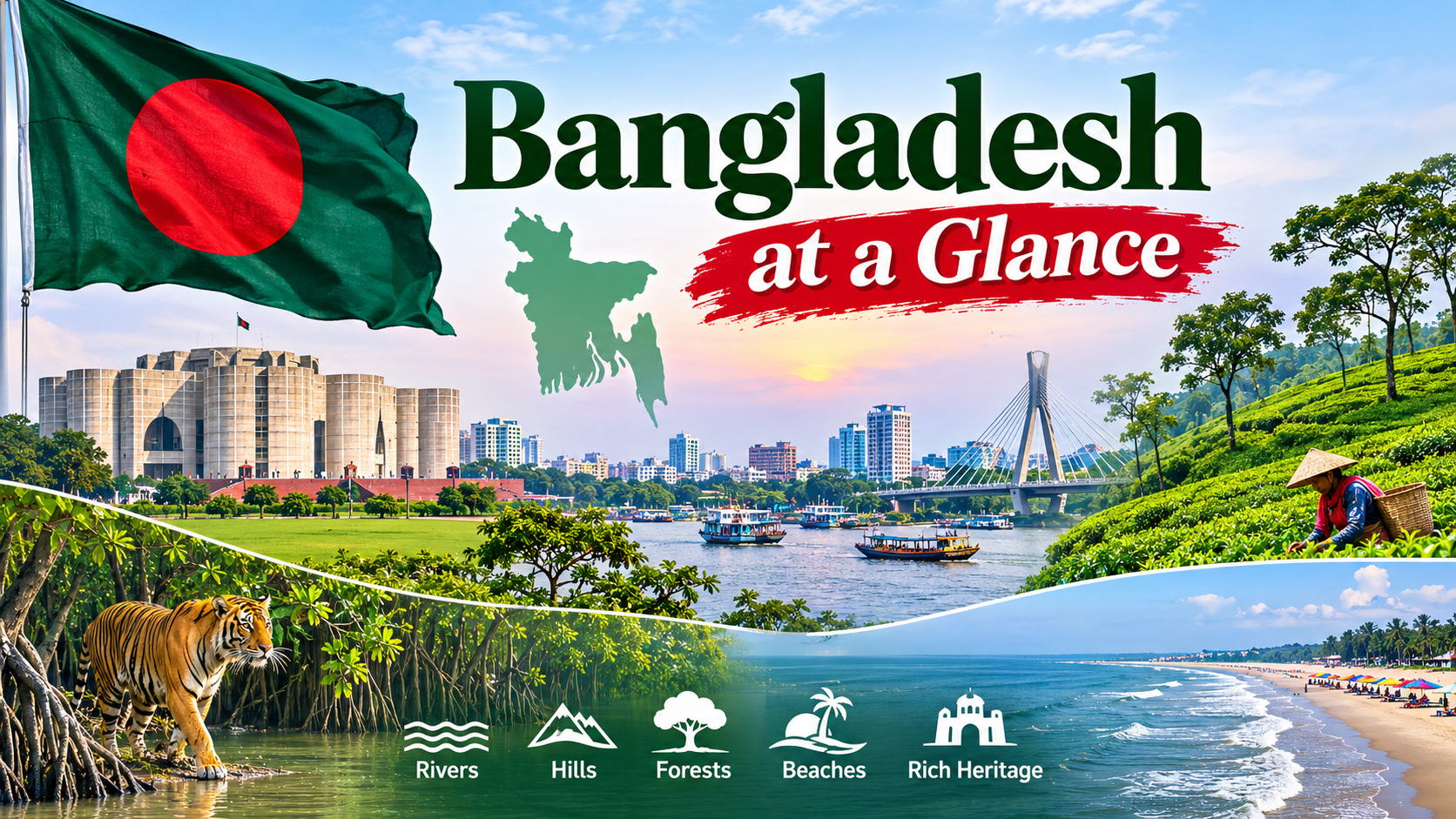
Bangladesh is an independent and sovereign country in South Asia, renowned for its beautiful rivers, fertile plains, lush green landscapes, rich history, diverse culture, and warm hospitality. Located in the world’s largest river delta, the country is often described as a land of rivers.
Officially known as the People’s Republic of Bangladesh, the country gained independence through the historic Liberation War of 1971. The struggle began with the declaration of independence on March 26, 1971, and culminated in victory on December 16, 1971, after nine months of war.
Today, Bangladesh is a densely populated country with a distinctive cultural identity, a vibrant society, and a developing economy. From the world’s largest mangrove forest to the world’s longest natural sea beach, Bangladesh offers remarkable geographical and cultural diversity.
Overview of Bangladesh
Bangladesh is a sovereign republic with its own constitution, national flag, national anthem, national emblem, currency, and national identity. Dhaka is the capital and the country’s principal centre of administration, business, education, and culture.
The people of Bangladesh are known as Bangladeshis, and Bangla is the state language. The country’s history, language, traditions, and cultural heritage play an important role in shaping its national identity.
Brief Profile of Bangladesh
| Information | Details |
|---|---|
| Official Name | The People’s Republic of Bangladesh |
| Short Name | Bangladesh |
| Capital | Dhaka |
| Region | South Asia |
| State Language | Bangla |
| Nationality | Bangladeshi |
| Independence Day | March 26 |
| Victory Day | December 16 |
| National Currency | Bangladeshi Taka |
| Currency Code | BDT |
| Currency Symbol | ৳ |
| International Dialing Code | +880 |
| Time Zone | Bangladesh Standard Time (UTC+6) |
| National Anthem | Amar Sonar Bangla |
| National Flag | Green with a red circle |
| National Parliament | Jatiya Sangsad |
| Major Religion | Islam |
| Total Area | 147,570 sq. km (commonly cited national figure) |
Area and Geographical Location of Bangladesh
Bangladesh is located in the northeastern part of the Indian subcontinent in South Asia. It occupies a major portion of the Ganges-Brahmaputra-Meghna delta, one of the largest and most fertile delta systems in the world.
The country shares most of its land borders with India and a southeastern border with Myanmar. The Bay of Bengal lies to the south.
Geographical Boundaries
- North: Indian states of West Bengal, Assam, and Meghalaya.
- South: Bay of Bengal.
- East: Indian states of Assam, Tripura, and Mizoram, along with Myanmar.
- West: Indian state of West Bengal.
Bangladesh is geographically situated approximately between 20°34′ and 26°38′ north latitude and 88°01′ and 92°41′ east longitude.
The commonly cited national land-area figure is 147,570 square kilometres. However, the United Nations Statistics Division’s World Statistics Pocketbook 2025 reports a surface area of 148,460 square kilometres. These figures may reflect different statistical definitions and should be attributed to their respective sources.
Major Geographical Features
Some of the most notable geographical features of Bangladesh include:
- The Bay of Bengal along the southern coastline.
- A vast network of rivers, canals, and waterways.
- Extensive fertile plains formed by alluvial deposits.
- Hilly landscapes in the southeastern region.
- The Sundarbans, the world’s largest mangrove forest.
- Coastal islands, wetlands, haors, and floodplains.
Population of Bangladesh
Bangladesh is one of the most densely populated countries in the world. A large population lives within a relatively small geographical area, making population density an important feature of the country’s demographic profile.
According to the United Nations’ World Statistics Pocketbook 2025, Bangladesh had an estimated population of approximately 175.687 million in 2025.
Key Characteristics of the Population
- Bangla is the language spoken by the vast majority of the population.
- People live in both rural and urban communities.
- Dhaka is the country’s largest urban centre.
- A substantial working-age population contributes to the national economy.
- Several ethnic minority communities enrich the country’s cultural diversity.
- Population growth and urbanization continue to influence housing, education, healthcare, and employment.
Capital and Major Cities of Bangladesh
Dhaka is the capital and largest urban centre of Bangladesh. It is the country’s principal hub for government administration, politics, business, education, healthcare, and cultural activities.
Besides Dhaka, several major cities play important roles in regional development, trade, industry, transportation, education, and tourism.
Major Cities in Bangladesh
- Dhaka: The capital and the country’s leading administrative, economic, and cultural centre.
- Chattogram: A major port city and an important centre of international trade.
- Khulna: A significant industrial and commercial city in southwestern Bangladesh.
- Rajshahi: Known for education, silk, mangoes, and its cultural heritage.
- Sylhet: Famous for tea gardens, natural landscapes, and religious heritage.
- Barishal: An important river-based city in southern Bangladesh.
- Rangpur: A major urban centre in the northern region.
- Mymensingh: Known for its educational institutions, agriculture, and cultural heritage.
- Cumilla: An important commercial and historical city in eastern Bangladesh.
- Narayanganj: A major industrial and commercial centre near Dhaka.
Each city has its own history, cultural identity, economic importance, and attractions for visitors.
National Flag and National Anthem of Bangladesh
The national flag of Bangladesh is one of the most important symbols of its independence, sovereignty, and national identity.
It consists of a dark green rectangular background with a red circular disc placed slightly towards the hoist side. The green background represents the country’s natural greenery, while the red disc is associated with the rising sun and the sacrifices made during the Liberation War.
The national anthem of Bangladesh is Amar Sonar Bangla, written and composed by Nobel Laureate Rabindranath Tagore. The first ten lines of the song serve as the national anthem.
The anthem expresses deep affection for the homeland, its natural beauty, and the emotional connection of the people with Bangladesh.
State Language and Currency of Bangladesh
State Language
Bangla is the state language of Bangladesh. The language holds a special place in the country’s history and national identity.
The Language Movement of 1952 was a historic struggle to establish Bangla as one of the state languages of Pakistan. On February 21, 1952, several students and activists sacrificed their lives during protests in Dhaka.
In recognition of this historic movement, February 21 is observed as Shaheed Dibosh (Martyrs’ Day) in Bangladesh and International Mother Language Day around the world.
National Currency
The official currency of Bangladesh is the Bangladeshi Taka.
- Currency Name: Bangladeshi Taka
- Currency Code: BDT
- Currency Symbol: ৳
- Central Bank: Bangladesh Bank
Bangladesh Bank is responsible for monetary policy, currency management, and regulating the country’s banking and financial system.
National Days of Bangladesh
Several important national days commemorate Bangladesh’s history, independence, language rights, and struggles for democracy.
February 21: Martyrs’ Day and International Mother Language Day
February 21 commemorates the language martyrs who sacrificed their lives during the Language Movement of 1952. It is observed as Shaheed Dibosh in Bangladesh and International Mother Language Day worldwide.
March 26: Independence Day
March 26 is celebrated as the Independence Day of Bangladesh. It marks the declaration of independence in 1971 and the beginning of the country’s Liberation War.
December 16: Victory Day
December 16 is observed as Victory Day. On this day in 1971, Bangladesh achieved its final victory after nine months of the Liberation War.
August 5: July Mass Uprising Day
August 5 is observed as July Mass Uprising Day in Bangladesh. The day commemorates the historic mass uprising of 2024 and honours those who sacrificed their lives during the movement.
The Government of Bangladesh declared August 5 an annual national observance through a Cabinet Division notification in July 2025.
Natural Beauty and Cultural Heritage of Bangladesh
Bangladesh is blessed with diverse natural landscapes and a rich cultural heritage. Its rivers, green countryside, hills, forests, beaches, and wetlands attract visitors from home and abroad.
Some of the country’s most remarkable natural and cultural attractions include:
- The Sundarbans: The world’s largest mangrove forest and home to the Royal Bengal Tiger.
- Cox’s Bazar: Famous for its long natural sandy sea beach.
- The Chittagong Hill Tracts: Known for scenic hills, forests, and diverse indigenous cultures.
- Sylhet: Renowned for tea gardens, waterfalls, and green landscapes.
- The Haor Regions: Seasonal wetlands known for their unique beauty and biodiversity.
- Paharpur: An important archaeological site featuring the ruins of an ancient Buddhist monastery.
Bangladesh is also known for its traditional music, folk culture, festivals, handicrafts, literature, cuisine, and hospitality.
Why Is Bangladesh Known as the Land of Rivers?
Bangladesh is often called the Land of Rivers because an extensive network of rivers and waterways flows through the country.
Major rivers include the Padma, Jamuna, Meghna, Brahmaputra, Teesta, Surma, and Karnaphuli. These rivers support agriculture, fisheries, transportation, trade, and everyday life.
The river systems also contribute to the formation of fertile floodplains, river islands, wetlands, and one of the world’s largest delta regions.
Conclusion
Bangladesh is a country with a remarkable history, a proud national identity, diverse natural landscapes, and a vibrant culture. Its journey to independence in 1971 remains a defining chapter in its national story.
From its busy cities and historic landmarks to its rivers, beaches, forests, and green countryside, Bangladesh offers a unique combination of natural beauty and cultural heritage.
Understanding Bangladesh’s geography, population, history, national symbols, and important facts provides a useful introduction to this fascinating South Asian nation.
Whether you are a student, researcher, traveller, or someone interested in learning about Bangladesh, this country profile offers a helpful starting point for exploring the country.
Frequently Asked Questions (FAQs)
1. What is the official name of Bangladesh?
The official name is the People’s Republic of Bangladesh.
2. Where is Bangladesh located?
Bangladesh is located in South Asia, bordered mainly by India, with Myanmar to the southeast and the Bay of Bengal to the south.
3. What is the capital of Bangladesh?
Dhaka is the capital of Bangladesh.
4. What is the state language of Bangladesh?
Bangla is the state language of Bangladesh.
5. What is the currency of Bangladesh?
The national currency is the Bangladeshi Taka (BDT), represented by the symbol ৳.
6. When did Bangladesh become independent?
Bangladesh declared independence on March 26, 1971, and achieved victory on December 16, 1971.
7. What is the population of Bangladesh?
The United Nations estimated Bangladesh’s population at approximately 175.687 million in 2025.
8. Why is Bangladesh called the Land of Rivers?
Bangladesh is called the Land of Rivers because numerous rivers and waterways flow through its territory and play an essential role in its geography, economy, and daily life.
9. What is the national anthem of Bangladesh?
The national anthem is Amar Sonar Bangla, written and composed by Rabindranath Tagore.
10. What is the national animal of Bangladesh?
The Royal Bengal Tiger is the national animal of Bangladesh.